Protecting Focus and Well-Being in High-Repetition Work Environments

Protecting Focus and Well-Being in High-Repetition Work Environments
Many modern jobs require employees to perform the same movements or tasks throughout the day. Administrative teams’ type for hours. Lab technicians repeat precise hand movements. Customer service representatives remain seated during long shifts. Manufacturing employees carry out identical motion patterns throughout production cycles. Even technology professionals often hold the same hand and neck position while working on computers for extended periods.
These patterns help organizations operate efficiently. However, when recovery is missing from the equation, physical strain and mental fatigue can slowly begin to build.
Over time, constant motion and sustained posture begin to affect both physical comfort and mental focus. The impact often develops gradually, making it easy to overlook—until productivity begins to slip, absences increase, or employees start looking for relief elsewhere.
The Physical Cost of Repeated Work Patterns
Musculoskeletal strain is one of the most widely documented health risks in workplaces that rely on constant task repetition. According to the U.S. Bureau of Labor Statistics, musculoskeletal disorders account for approximately 30% of workplace injuries that require days away from work. The Occupational Safety and Health Administration (OSHA) identifies motion patterns and awkward posture as leading contributors to these injuries.
Forward head posture, which is common in desk-based roles, significantly increases the load placed on the cervical spine. Biomechanical research shows that when the head shifts forward even slightly, the force placed on the neck increases dramatically. Over time, this can lead to chronic tension, headaches, and upper-back discomfort.
Physical discomfort is more than a wellness concern—it affects how people work. Pain can reduce attention, slow reaction time, and increase the likelihood of mistakes. Employees dealing with ongoing discomfort often work more cautiously or pause more frequently, which can influence workflow consistency and overall output.
Mental Fatigue and Task Monotony
Work that follows the same motion patterns can also influence mental energy. Occupational research shows that highly repetitive task cycles reduce cognitive stimulation and can lead to mental fatigue.
Gallup reports that disengaged employees are 18% less productive than engaged teams. When work becomes monotonous, concentration can fade, decision-making becomes slower, and motivation can begin to decline. Over time, the combination of physical strain and mental fatigue may limit creativity and problem-solving ability.
This challenge is particularly important in detail-driven roles where sustained focus and precision are essential.
The Stress Physiology Connection
High workloads combined with constant task cycles can also elevate stress levels. When pressure remains high for long periods, the body produces more cortisol, a stress hormone that research links to reduced memory function and impaired executive decision-making.
The American Institute of Stress estimates that workplace stress costs U.S. employers over $300 billion each year through absenteeism, healthcare costs, and turnover. The Centers for Disease Control and Prevention (CDC) also estimates that productivity losses related to absenteeism alone exceed $225 billion annually.
When stress begins affecting the body—not just emotions—it can influence patience, communication, and the overall workplace atmosphere.
Without intentional recovery, these effects can compound over time.
The Case for Structured Recovery
The body is designed for cycles of exertion and recovery. Repetitive work environments often emphasize exertion while neglecting structured recovery.
This is where in-office chair massage becomes operationally relevant.
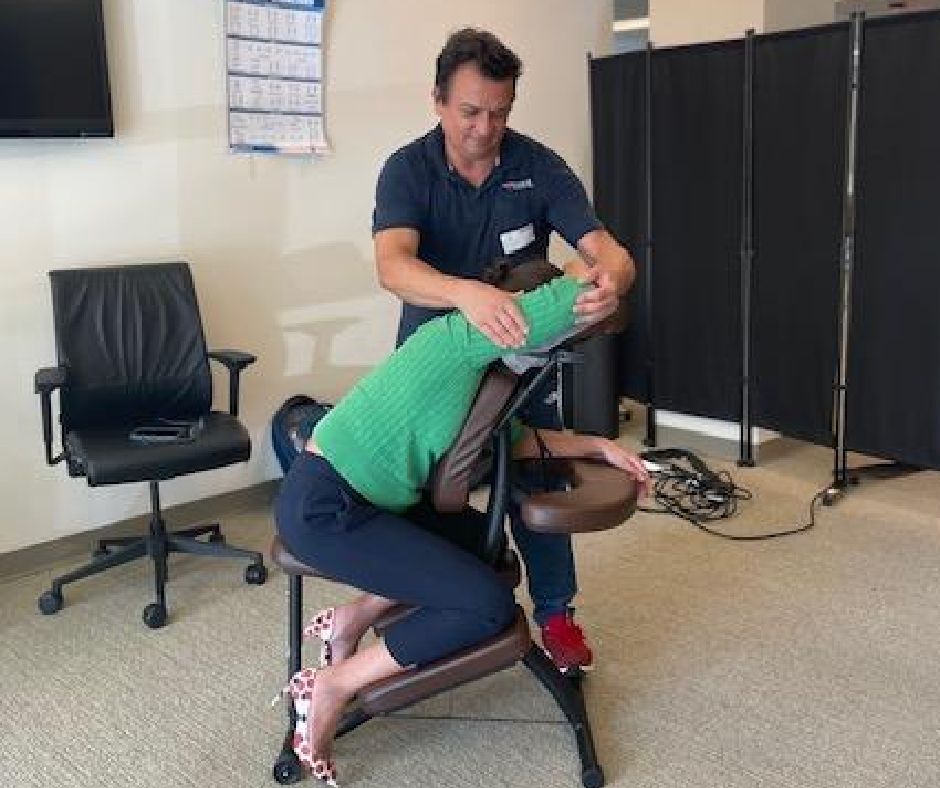
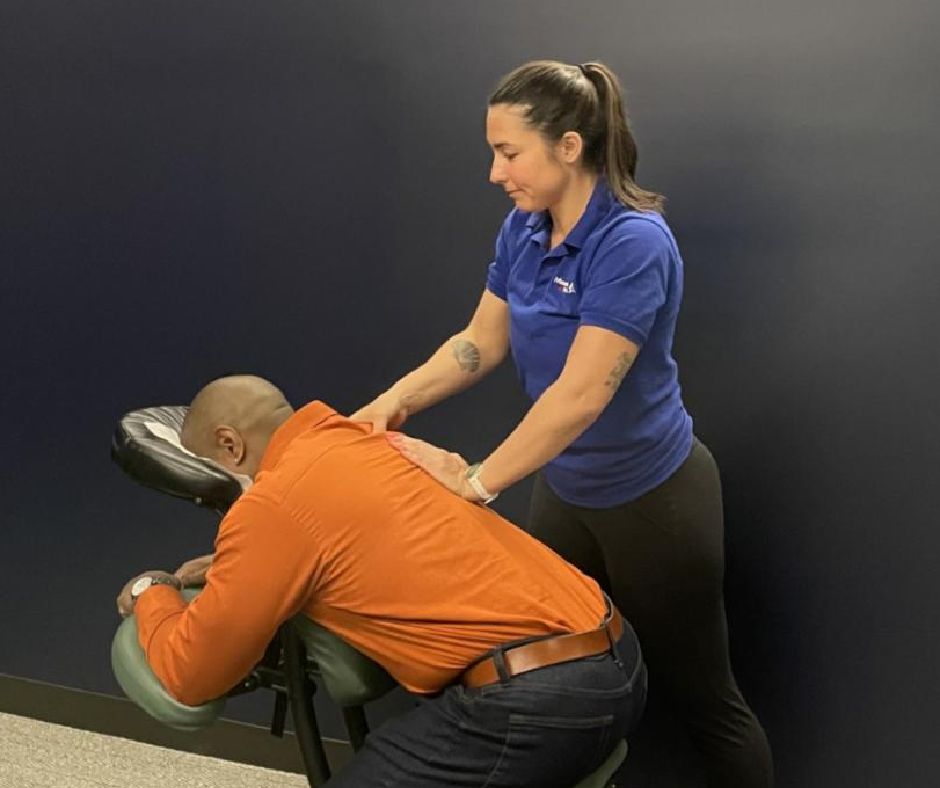
Massage therapy focuses on the muscle groups most affected by repetitive movement—particularly the neck, shoulders, back, arms, and hands. Research published in the International Journal of Neuroscience shows that massage can significantly reduce cortisol while increasing serotonin and dopamine, neuro chemicals associated with emotional balance, motivation, and mental clarity.
Lower cortisol levels support clearer thinking. Increased serotonin and dopamine help improve mood and concentration.
Massage also improves circulation in overworked muscle groups, helping reduce stiffness and restore mobility. Even short sessions lasting 10–20 minutes can trigger the parasympathetic nervous system—the body’s natural recovery response.
Scientific Support for Workplace Massage
Clinical studies have shown that massage therapy can lower anxiety levels, reduce heart rate, and improve overall stress perception. Research conducted in occupational settings has also demonstrated that short massage sessions can improve mood and reduce fatigue during the workday.
When employees return to their responsibilities feeling physically relieved and mentally calmer, their ability to concentrate often improves. Decision-making becomes clearer, and emotional reactivity tends to decrease.
In environments where work patterns remain constant throughout the day, these changes can make a meaningful difference in consistency and output.
Operational Benefits for Employers
In-office chair massage works particularly well in structured workplace settings because it requires minimal disruption. Sessions are brief, employees remain fully clothed, and no oils or equipment changes are required.
More importantly, chair massage addresses both the physical and physiological effects created by constant task repetition.
By incorporating structured recovery into the workweek, organizations can:
• Reduce accumulated muscle tension
• Support sustained attention and accuracy
• Decrease fatigue linked to stress
• Strengthen employee morale and retention
• Help maintain consistent productivity
Efficiency may rely on repeated motion, but long-term workforce health depends on balanced recovery.
A Preventative Infrastructure Approach
Massage At Work provides on-site chair massage programs designed specifically for corporate environments. Our services integrate smoothly into existing workflows while offering employees a practical way to reset physically and mentally during the workday.
When organizations address physical strain early, they reduce the likelihood that discomfort will develop into injuries, burnout, or employee turnover.
Declines in workplace effectiveness rarely happen overnight. They build gradually over time.
Supporting recovery helps prevent that erosion.
If your organization depends on consistent task execution throughout the day, it may be worth evaluating how recovery is incorporated into your workplace routine.
Massage At Work can help you introduce a structured, research-supported approach to protecting both employee well-being and long-term workplace productivity.
Citations:
U.S. Bureau of Labor Statistics
U.S. Bureau of Labor Statistics. (2023).
Employer-Reported Workplace Injuries and Illnesses.
https://www.bls.gov/news.release/osh.nr0.htm
Occupational Safety and Health Administration
Occupational Safety and Health Administration.
Ergonomics: Prevention of Musculoskeletal Disorders.
https://www.osha.gov/ergonomics
Hansraj, K. K. (2014).
Assessment of Stresses in the Cervical Spine Caused by Posture and Position of the Head.
Surgical Technology International.
American Institute of Stress
American Institute of Stress.
Workplace Stress Statistics.
Gallup
Gallup. (2023).
State of the Global Workplace Report.
https://www.gallup.com/workplace/349484/state-of-the-global-workplace.aspx
Centers for Disease Control and Prevention
Centers for Disease Control and Prevention.
Worker Productivity Loss from Health-Related Absenteeism.
https://www.cdc.gov/workplacehealthpromotion
Field, T., et al. (2005).
Massage Therapy Effects.
International Journal of Neuroscience.
 A Certified LGBT Business Enterprise ®
© 2026 Massage At Work USA, LLC. The Corporate On-Site Massage Professionals™. All Rights Reserved.