
Stress at Work: A Small Change That Creates a Bigger Impact
Stress at Work: A Small Change That Creates a Bigger Impact
Stress has become part of the modern workday. Tight schedules, constant communication, and long hours can quietly wear employees down over time. It’s not always obvious at first. Most people keep pushing through until the effects begin to show—fatigue, irritability, lack of focus, or even physical discomfort.
What many companies are starting to realize is that stress doesn’t just affect the individual. It affects the entire workplace.
When employees feel overwhelmed, their ability to stay focused, communicate clearly, and stay engaged begins to shift. Over time, this impacts team energy, workflow, and overall results.
But when employees feel supported, something different happens.
Why Stress Matters More Than We Think
Stress is not just mental—it shows up in the body. Muscle tension builds, posture weakens, and energy levels drop. These changes make it harder for employees to stay present and do their best work.
Research from American Institute of Stress shows that workplace stress costs U.S. companies over $300 billion each year due to absenteeism, healthcare costs, and employee turnover.
Another study supported by the Centers for Disease Control and Prevention found that productivity losses from absenteeism alone exceed $225 billion annually.
These numbers reflect something simple: when stress is ignored, it spreads.
How Feeling Valued Changes Everything
Employees don’t just want to complete tasks—they want to feel appreciated while doing them.
When a company invests in employee well-being, it sends a clear message: you matter here.
That message has a real effect.
Research from Gallup shows that employees who feel supported and engaged are more productive and more likely to stay with their organization long term.
Feeling valued builds trust. Trust builds loyalty. And loyalty creates stronger, more connected teams.
Where Chair Massage Makes a Difference
Sometimes, the most effective solutions are also the simplest.
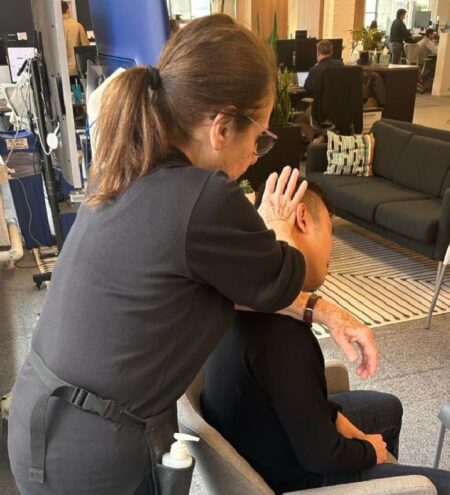
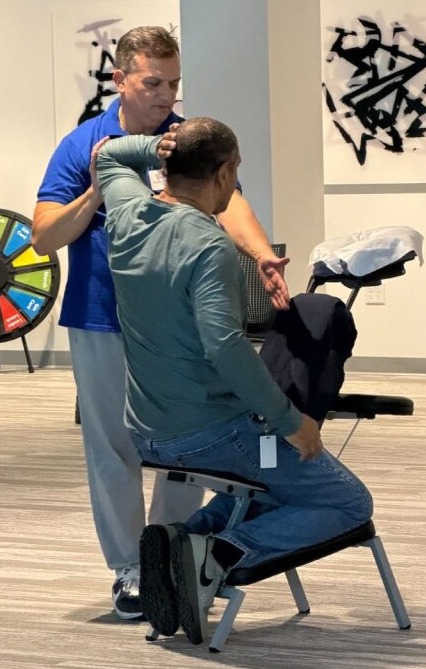
Chair massage gives employees a chance to pause during the workday. Even a short session allows the body to release built-up tension while giving the mind a break from constant demands.
Massage therapy has been shown to reduce stress in measurable ways. Research published in the International Journal of Neuroscience found that massage can lower cortisol levels while increasing serotonin and dopamine—chemicals linked to mood, focus, and emotional balance.
A more recent review published in Complementary Therapies in Clinical Practice (2020) also found that massage therapy helps reduce anxiety and improve overall well-being in workplace and clinical settings.
When employees return to their desks after even a brief session, they often feel lighter, clearer, and more grounded.
The Ripple Effect Beyond the Workplace
When employees feel better at work, it doesn’t stop there.
They bring that energy home. They interact differently with their families. They carry less stress into their personal lives. Over time, these small changes contribute to healthier routines and better overall well-being.
Workplaces have more influence than they realize. When companies create environments that support health and balance, they contribute to a larger shift—one where taking care of people becomes part of how business is done.
Healthier employees lead to healthier communities.
Building a Workplace People Want to Stay In
Retention isn’t just about salary or benefits anymore. It’s about how employees feel on a daily basis.
When people feel taken care of, they are more likely to stay, contribute, and grow within the organization. They don’t just show up—they invest themselves in their work.
Chair massage creates a simple but meaningful experience that employees remember. It shows effort. It shows care. And it creates a workplace people don’t want to leave.
A Simple Step Toward a Healthier Workplace
Massage At Work provides onsite chair massage programs designed to support employees in a real, tangible way. These sessions fit into the workday without disruption, giving employees a moment to reset both physically and mentally.
Small changes like this can shift the entire tone of a workplace.
When employees feel supported, they work differently.
When they work differently, teams feel it.
And when teams feel it, companies grow stronger.
Sometimes, improving the workplace doesn’t require a major overhaul.
Sometimes, it starts with giving people a moment to breathe.
Citations:
- American Institute of Stress
Workplace Stress Statistics
- Centers for Disease Control and Prevention
Productivity Loss from Absenteeism
- Gallup
State of the Global Workplace Report
- Field, T., et al. (2005).
Massage Therapy Effects. International Journal of Neuroscience.
- Rapaport, M. H., et al. (2020).
Massage therapy for psychiatric disorders and stress reduction.
Complementary Therapies in Clinical Practice.
 A Certified LGBT Business Enterprise ®
© 2026 Massage At Work USA, LLC. The Corporate On-Site Massage Professionals™. All Rights Reserved.